Nash Equilibrium in Non-Cooperative Games
What does this application do?
Based on the mathematical concept developed by John Nash, this app allows users to study strategic situations where two or more players act independently.
The goal is to demonstrate how stable states (equilibria) are reached where no player has incentives to unilaterally change, illustrating phenomena such as the prisoner's dilemma.

Features and Usage
- 1 Simulate Models: Interact with payoff matrices and experiment in real time.
- 2 Calculate Equilibria: Automatically identify best responses and Nash equilibria.
- 3 Registration and Login: Create your account to save your custom simulations and scenarios.

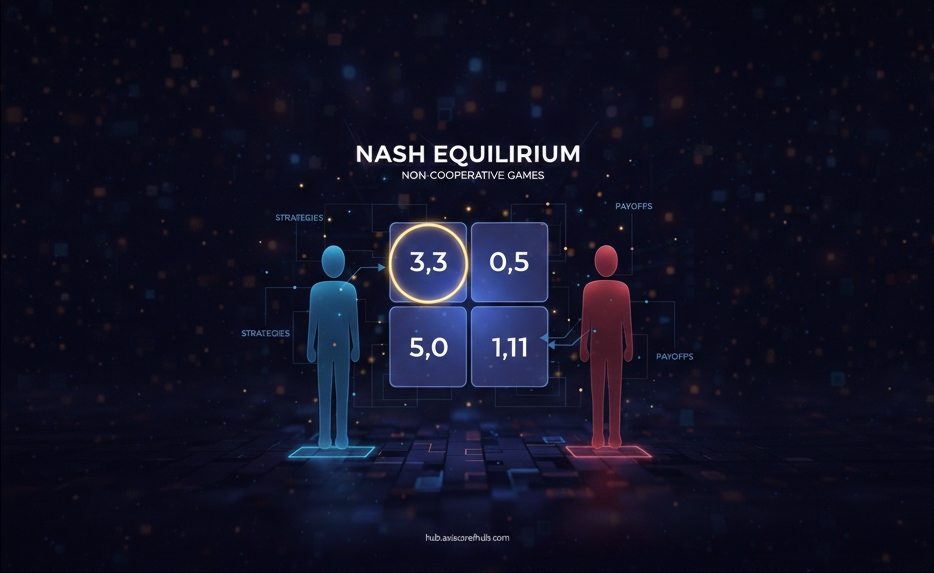
In game theory, the Nash equilibrium, named after the mathematician John Nash, is the most common way to define the solution of a non-cooperative game involving two or more players. In a Nash equilibrium, each player is assumed to know the equilibrium strategies of the other players, and no player has anything to gain by changing only their own strategy.
For a basic 2x2 payoff matrix, we look for a pair of strategies where neither player can increase their payoff strictly by deviating, given the other player's choice.

What is it?
A stable state of a system involving the interaction of different participants, in which no participant can gain by a unilateral change of strategy if the strategies of the others remain unchanged.
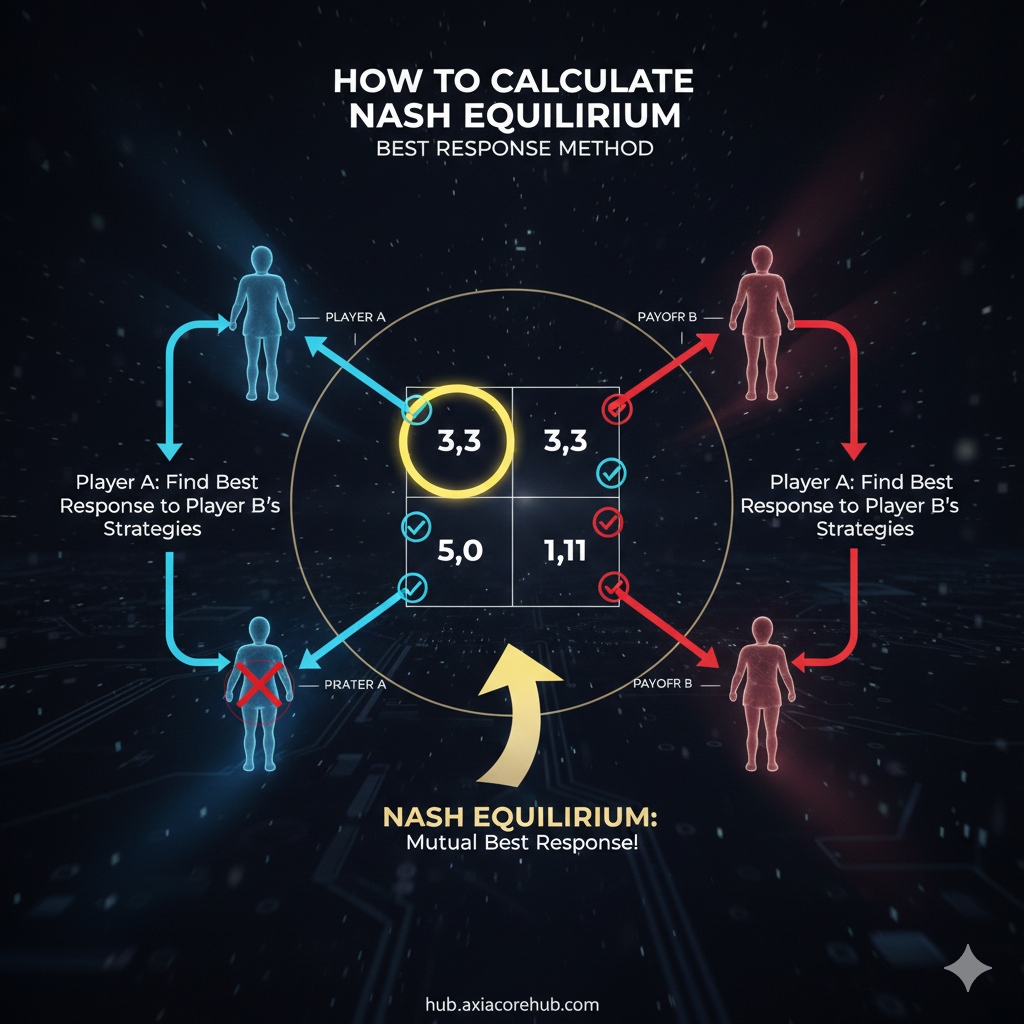
How to Calculate
For player A, find the best response strategy for each of player B's strategies. Do the same for player B. If a cell in the matrix represents a best response for both players simultaneously, that cell is a Nash Equilibrium.
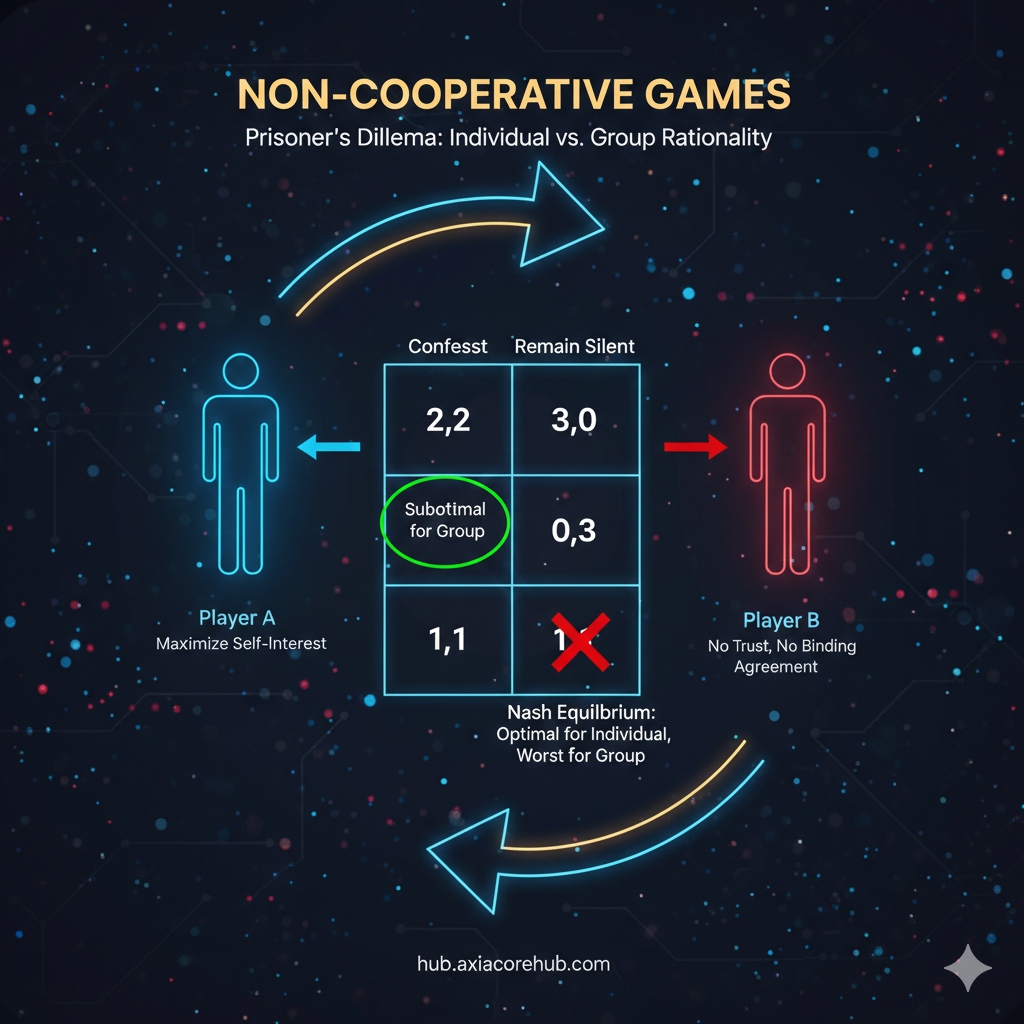
Non-Cooperative
This model assumes players cannot form binding agreements. Each acts independently to maximize their own self-interest, often leading to outcomes that are not optimal for the group (like in the Prisoner's Dilemma).